LIVING IN THE BORDERLANDS | Gurvich Museum
Updated: Aug 2
Danilo Espinoza (CL) - José Gurvich (LT) - Teresa Puppo (UY)
“I am what I am, something without a name” — Letter from José Gurvich to Horacio Torres, 1965
“They would like to think that I have melted into the crucible. But I have not melted, we have not melted.” — Borderlands/La Frontera (1987), Gloria Anzaldúa
A poem by Mexican-American writer and activist Gloria Anzaldúa served as the starting point to explore the practices of three artists from different times and territories, who suggest the possibility of envisioning contemporary societies as a woven fabric of identities. The works of Teresa Puppo, Danilo Espinoza Guerra, and José Gurvich draw on the languages and materiality of fire, smoke, cotton, and clay to inhabit those interstitial spaces between multiple subjectivities, where boundaries become blurred.
In the search for a metaphor that illustrates a space embracing multiple identities, Bolivian sociologist Silvia Rivera Cusicanqui points out that the notion of territory is incomplete without its complementary notion of weaving. The ch’ixi represents this fabric made up of a diversity of identities and epistemes which, instead of being annulled in the mix, coexist and together form an entity.
The idea of fluidity when speaking of multiple identities seeks to soften the boundaries of a mosaic that contains different textures and narratives. Under this premise, identities are malleable, and their fragments move freely in and out of the whole. Living on the Borders brings together works with the characteristics of contemporary decolonial art that resists melting into the crucible. The bare texture of fired clay and charcoal, the fragility of smoke before the voracity of fire, function as stimuli that open the imagination to new ways of coexisting with territory.
Teresa Puppo explores the dimension of fire as a climatic agent that shapes not only landscapes but entire communities, which experience a loss of their material, symbolic, and spiritual bond with the land. Barely a decade ago, the term Pyrocene began to be used to describe a geological era in which the loss of control over fire results in a world where unprecedented-scale wildfires replace humans in their role as sculptors of landscapes.
In the exhibition, we see fire as one of the most versatile and powerful instruments of Indigenous peoples, while at the same time we witness its complete ungovernability as a result of unprecedented human activity.
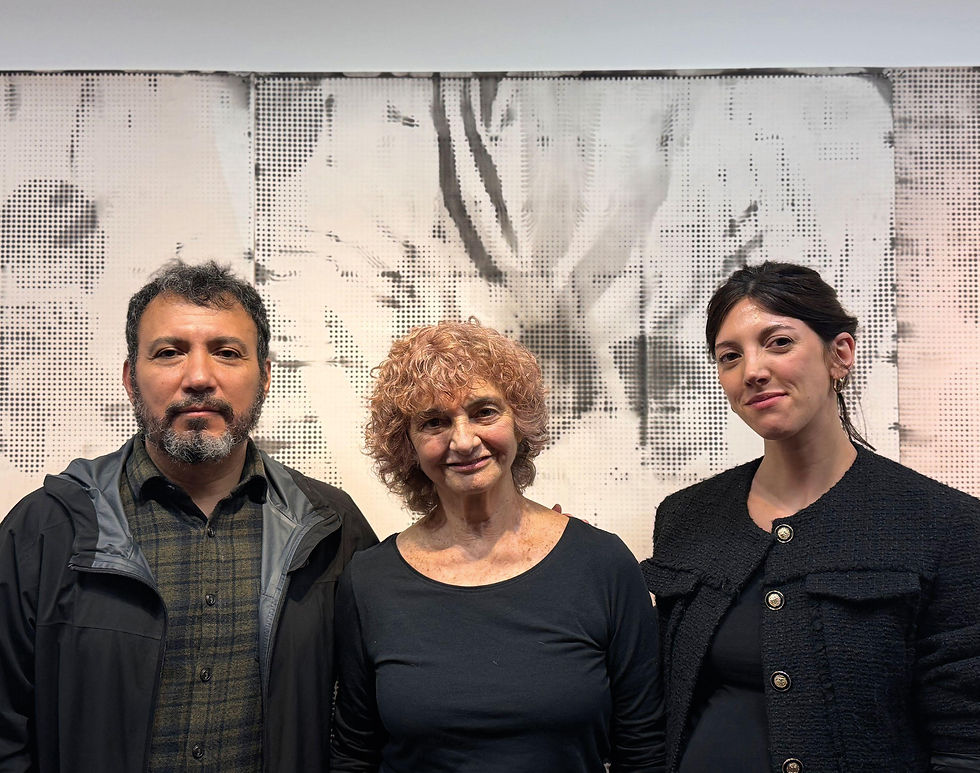
Danilo Espinoza Guerra makes use of smoke in a hybridization of techniques that incorporate elements of drawing, photography, and printmaking. The temporality of the artistic process connects Mapuche stories with his own biography, and along the way questions arise regarding the hybrid nature of most of the Chilean (and Latin American) population, the politics of identities, and the re-signification of knowledge and crafts linked to family history. Smoke permeates Danilo’s work with the same naturalness with which it imbues Mapuche domestic life: textiles, food, and even vision itself within homes and across landscapes disrupted by volcanic ash. Smoke and soot contain within their essence the materiality that preceded them and, in this sense, become a powerful expressive resource in the service of the Mapuche people’s historical struggle for their territorial identity.
The exhibition includes a selection of sculptures by José Gurvich. In the context of his home-studio in the Cerro neighborhood of Montevideo, the ceramics of this Jewish artist of Lithuanian origin are part of a collective practice that goes beyond creative exchange, encompassing walks with his students to the Pantanoso stream, the preparation of clay, and the firing of the pieces in a neighbor’s kiln. Gurvich’s figures retain the color of the earth, yet they are in constant transformation, permeated by territory, history, and relationships. In his own words, they inhabit “a free and unlimited space, where ‘everything is possible,’ where everything fraternizes with everything.”
Living on the Borders exposes us to relegated identities, but seeks to do so not through testimony but through sensory experience, inviting us to imagine ways of living that honor our right to a complex identity—one that transcends cultures, geographies, and temporalities.
